
Discovery Day, March 2026
Issue No. 2 — Honest Ground

There is a particular kind of quiet that settles over you at a barn. Not silence, exactly. There’s always something happening, some ambient animal rummaging about at the edges. But it is a quiet that slows your nervous system before your mind has time to negotiate with it. Before you have decided to relax, your body already has.
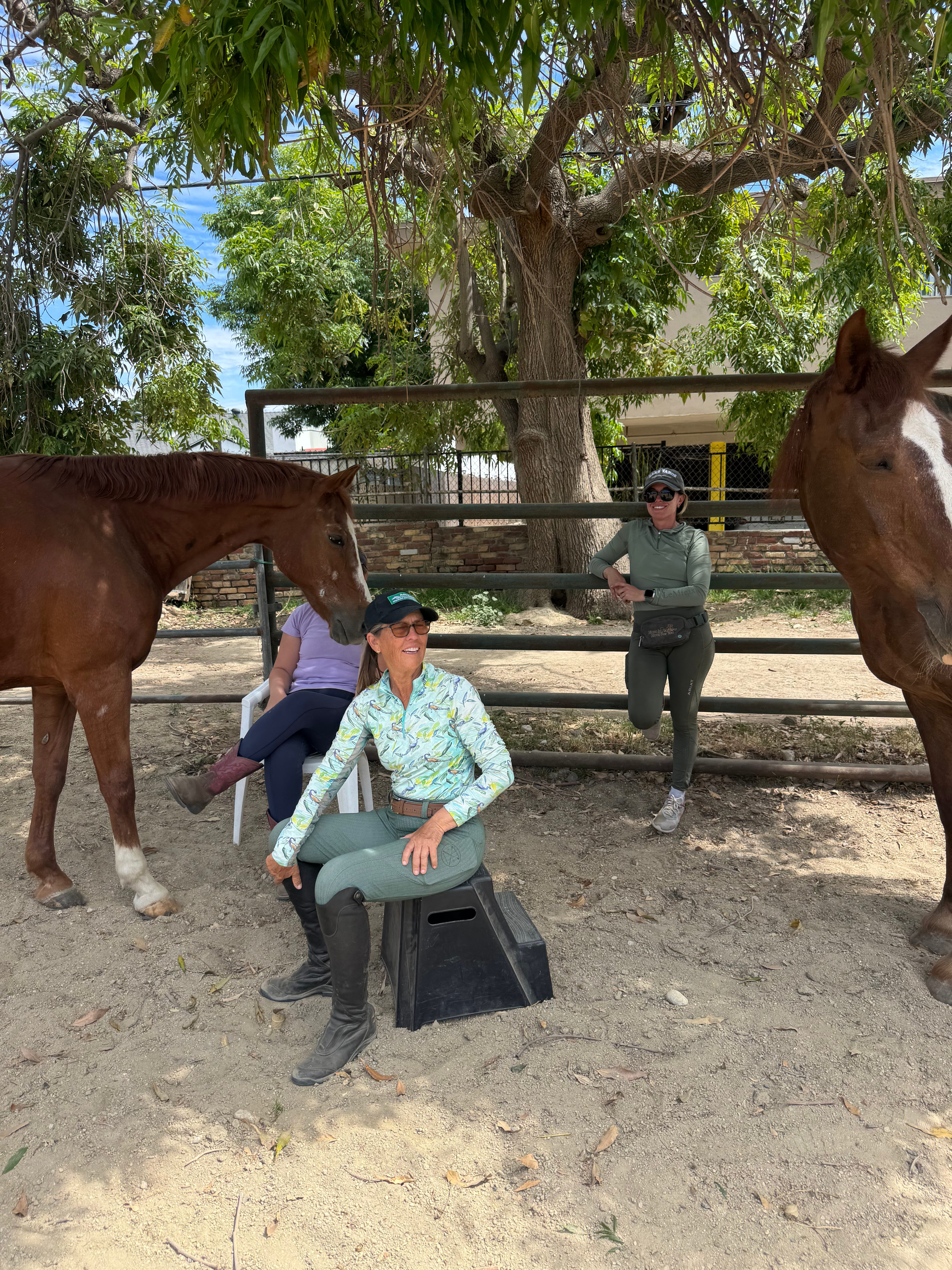
That is where we started yesterday. A shaded dirt path. Six adults, some chairs, snacks, sun hats, and three horses going about their very ordinary, very instructive lives.
I’ll be honest with you: I was terrified about putting this event on the calendar. In hindsight, it might not have been the best timing (spring break started this week). The timing was imperfect, and I’m still building a vocabulary - as a facilitator, as a founder - for how to invite people into something that doesn’t yet have a lot of external evidence behind it. Something that requires you to trust the experience before you’ve had it.
What if nobody signed up or what if many people did? Was I ready? I didn’t feel ready. But as they say, you have to start somewhere. And so, with one person signed up, we began.
What Actually Happened
Two older geldings, Dale and Buddy, shared one paddock. Ruby, a young mare, had her own adjacent space, separated by a fence they could all see through. A chicken wandered in from the neighboring yard. There was a turtle. Another horse poked his head over the fence occasionally, curious about whatever the humans were doing.
We started with a question: How did you wake up this morning? And how has that feeling shifted across the day?
Then we just watched.
Dale rolled in a sandy patch, completely unbothered. Buddy rolled near the fence closest to Ruby, showing off, maybe, or marking his position, and then drifted over to investigate the cluster of humans gathered near Dale. Buddy’s neck was bowed, ears forward, and engaged. Curious. But also, unmistakably, the energy of someone who very much wanted to be the center of things. Like a younger brother.
Dale pinned his ears. He had found his shaded corner near the humans, and he intended to stay in it.
For a few minutes, they existed in that negotiation. And then a chicken came flying out of the neighboring yard, and both horses exploded across the paddock in a burst of galloping, bucking, squealing alarm.
Then they came trotting back. Right back to the fence, to where the humans were.
Because that’s what horses do. They process the disruption fully, expressively, without apology. Horses tend not to hold grudges; they remember but don’t replay things. The threat passed, so they let it pass.
We talked about that for a while.
When we moved our chairs into the paddock, things changed. Buddy planted himself in the center of the circle of chairs immediately, making himself impossible to ignore. One participant stood up and moved away from him, not dramatically, just quietly, and when I asked her about it, she said she felt unsafe. She was near his hind end, in kicking range. Her instincts were exactly right.
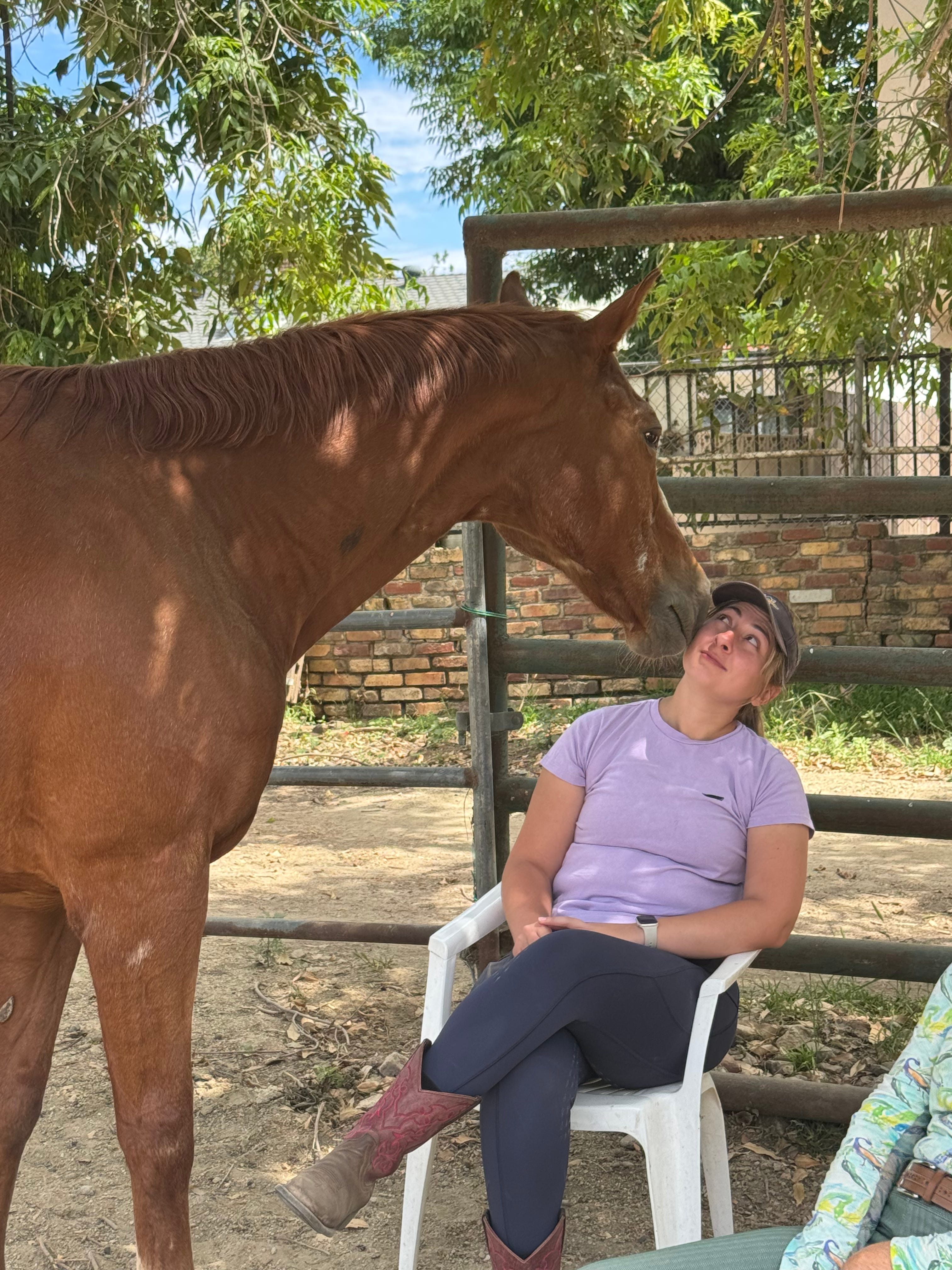
What does it feel like to trust an instinct like that? To just move, without explaining yourself or apologizing?
Meanwhile, Ruby had begun pacing the fence line of her separate paddock. Back and forth, back and forth, the way a body moves when it cannot settle. The humans were all in the other paddock. The attention was elsewhere. She was on the outside of something she wanted to be inside of.
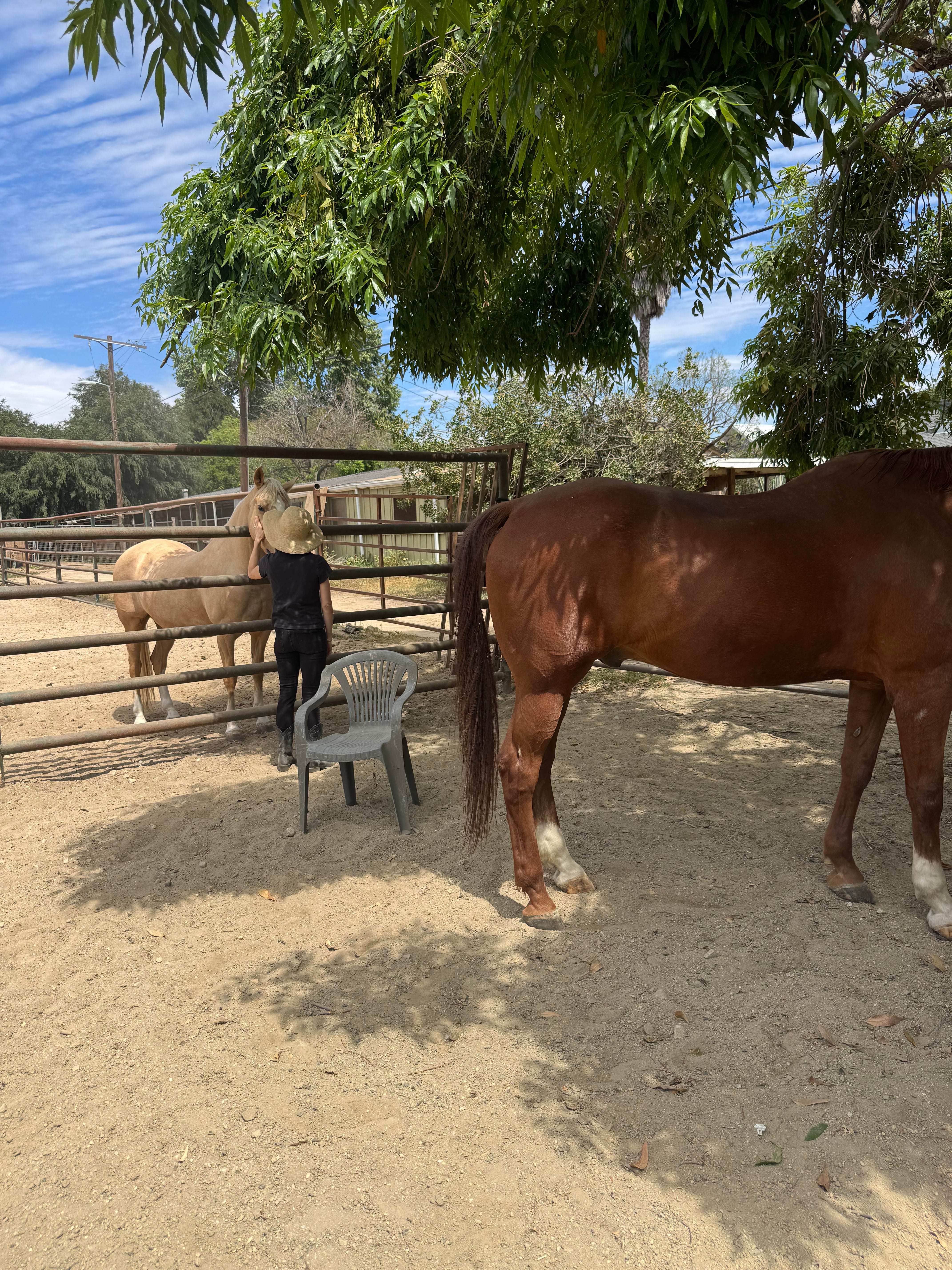
We noticed this together.
We then moved into her paddock, and Dale retreated to his corner, unbothered. Buddy became frustrated at the gate between the two paddocks, pawing at the sand, insistent and agitated. He wanted back in. He wanted whatever was happening over there. He hadn’t been excluded for long, but the exclusion was intolerable to him.
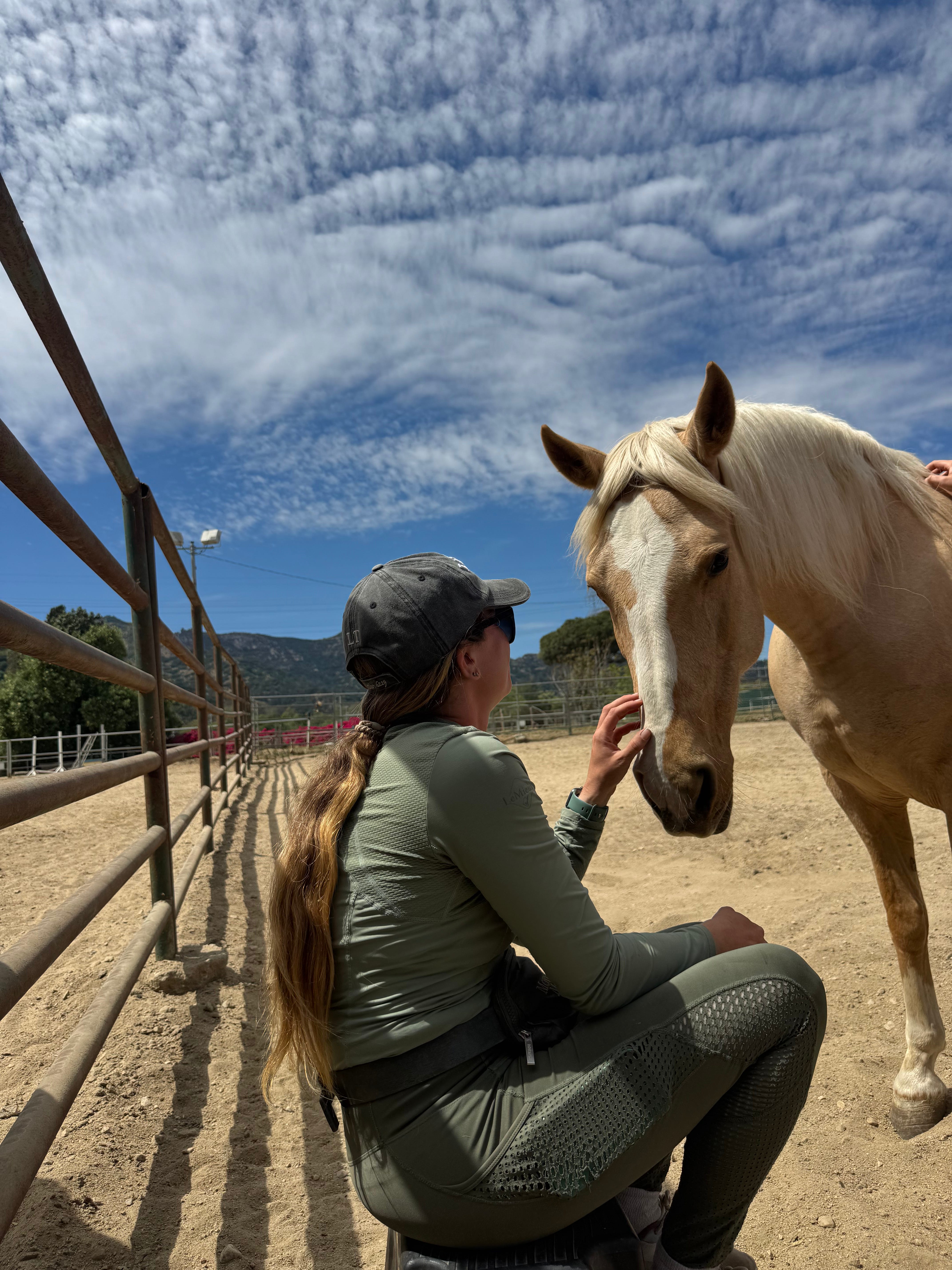
Dale stood in his shade and blinked.
We closed the workshop with a positive reinforcement demonstration, both geldings working with targets, Buddy being asked to touch their noses to his cone, and Dale holding his position with treats provided each time Buddy touched his nose to his cone. The idea wasn’t to teach the training methodology, but to see whether a structured interaction might reveal other dimensions of behavior and provide different things to reflect on that pure observation hadn’t incited.
It did.
Buddy couldn’t regulate. He began to fixate on the cones, treating them as resources he needed to protect from Dale. He became aggressive, not dangerous, but agitated, increasingly unable to switch contexts, unable to do the simple things he already knew how to do. The trainer worked to bring him back to something familiar. It didn’t land. He was too far into his own alarm.
Dale stayed at his cone. Calm. Doing what he thought he was supposed to do. Patient with the system. I watched a bit heartbroken as he stood there calmly. The attention moved entirely to Buddy’s dysregulation, and Dale, who was getting it right and was doing exactly what was asked, stopped receiving any feedback at all. He just stood there, still working, unrewarded, waiting for a signal that didn’t come.
We sat with that for a long time.
What emerged were questions about family dynamics, workplace teams, about what it means to be the one who is regulated while someone else’s dysregulation consumes all the oxygen in the room. We spoke more about resource protection, and about how when we don’t name what matters to us, when we don’t understand what we’re actually trying to protect and why, we sometimes destroy the thing we were trying to hold.
For me, it brought to mind blended families. About what it looks like when one person’s need for centrality reorganizes everyone else’s experience, and the people who are simply doing what they were told, quietly, faithfully, staying at their cone. And how they get left without a signal. Not out of cruelty, but out of the necessity for calming the chaos of one person.
The horses showed us this in about forty minutes. Without a single word of instruction.
What I Was Still Learning
I had a high-level outline. I had snacks and sun hats and an extra copy of my one-pager. What I didn’t have yet and what I’m still building is the intuitive fluency that makes facilitation feel like conversation rather than curriculum delivery.
There were moments when I felt the urge to fill the space. When my mind went a little blank at the fence line I reached for a question that didn’t quite fit. And then I felt myself stop, and I thought: isn’t this the point? To just be here? To let the horses do what they do and trust that it’s enough?
It was enough.
A chicken scared two horses into a gallop. They came back. A gelding couldn’t let go of a cone. Another one waited patiently in the shade. A mare paced a fence line, and then the fence came down, and she stopped pacing. Six adults, five who knew each other and one who didn’t, sat in a paddock on a sunny spring afternoon and let horses rest their chins on shoulders, tug at hats, nuzzle cheeks, stomp at cones.
Somewhere in all that, we could recognize ourselves.
I could feel the conversation wanting to continue. I could feel how much more was sitting just under the surface, especially around the resource protection piece. It could anchor an entirely new session, one experience building off the other across time.
More Discovery Days are coming. Different audiences, different questions, different mixes of people sitting in shaded paddocks along the Los Angeles River. Where horses can just be horses and chickens can just be chickens. All of us with different experiences of time against a faraway backdrop of cars whizzing by on the 101 highway.
That is Honest Ground. I’ll see you at the barn.
Susan Schaffler is the founder of Unbridled Rising, a youth and young-adult enrichment program in Southern California. Discovery Days are coming to new audiences who are curious. If you want to know when the next one is, get on the list.
Something powerful happens when we don’t have to fill spaces with language but get to experience the language of proximity. Able to just be with our senses. Love this Su! A big win - especially for the “doing it when not ready”
So interesting what people take away from the time spent together. I really appreciate you and the other participant Lauren wrote about the experience. Wriring is a great skill and thank you for sharing it with us.